Underutilized office space: Calculate your lost revenue and take action
June 5, 2026
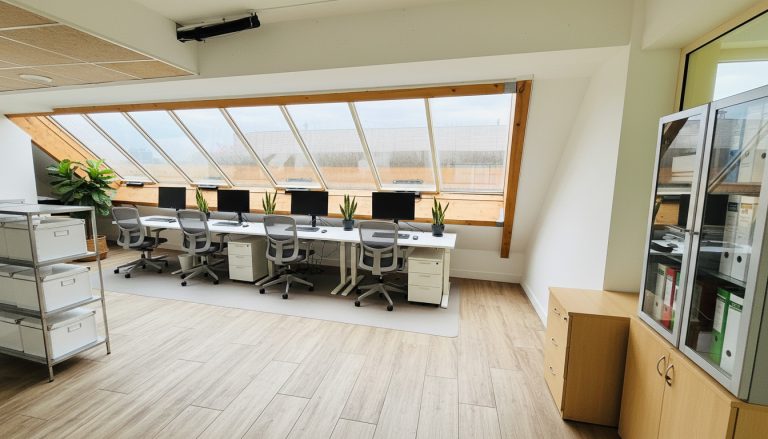
An empty workspace isn’t cost-neutral: it still incurs rent, utilities, and service charges. When you add it all up, the cost of underutilized office space surprises most executives. Here’s how to calculate it.
An unused workstation in Paris costs an average of between €6,000 and €12,000 per year when rent, utilities, energy, and services are added together. For underutilized offices, the total cost for 10 vacant workstations is more than €100,000 per year. According to service-public.fr, commercial subleasing is subject to the landlord’s prior consent.
The rent is just the tip of the iceberg
When a business leader thinks about the cost of underutilized office space, they think of rent. However, that is far from the only expense. Every square meter of office space in Paris comes with rental charges, taxes, energy costs, cleaning, maintenance, and reception services. All of these costs are calculated based on the total square footage—whether it is occupied or not.
In other words, when half of your underutilized office space sits empty several days a week, you’re not just losing half your rent—you’re also paying to heat, light, clean, and maintain spaces that no one is using.
Cost items that are often overlooked
Beyond rent and obvious operating costs, there are several expenses associated with underutilized office space that often go unnoticed:
- Energy: Heating , air conditioning, and lighting are often left on for the entire floor, regardless of how many people are present.
- Cleaning and maintenance: Services are generally billed based on floor space, not actual occupancy.
- Services and facilities: reception , security, season tickets, and equipment are all geared toward a full roster.
- Depreciation of fixtures and fittings—such as furniture , partitions, and equipment—represents an investment that generates no value when the space is vacant.
- Opportunity cost: This is the most significant yet least visible factor—every vacant position represents potential revenue you’re giving up.
A simple method for calculating your lost revenue
To estimate the true cost of your underutilized office space, follow these four steps:
- Calculate your total annual occupancy costs: rent + utilities + energy + cleaning + maintenance + services.
- Divide this total by the number of workstations to get the annual cost per workstation.
- Estimate your average actual utilization rate (the number of workstations actually in use on a typical day, divided by the total number of workstations).
- Multiply the cost per position by the number of positions that are permanently unused: that gives you your annual waste.
Example: A company pays €240,000 per year in total costs for 30 workstations, or €8,000 per workstation. If 10 workstations remain vacant for an extended period, the cost of the unused space amounts to €80,000 per year.
What causes the result to vary
Two companies of similar size can end up with very different figures. The key factors are the arrondissement (the cost per square meter varies significantly across Paris), the actual occupancy rate (which depends on the company’s remote work policy), and the proportion of fixed costs that cannot be reduced. The higher the rent and the lower the occupancy rate, the greater the waste—and the more attractive subleasing becomes.
Initial setup: a CAPEX item often overlooked in calculations
Renovation work is almost always excluded from the calculation of occupancy costs—wrongly so.
In Paris, fitting out an office costs between €500 and €1,500 per square meter, depending on the level of finish: partitions, network cabling, furniture, signage, and kitchen facilities. These costs are amortized over the term of the lease (6 or 9 years). If you move out early, you lose the portion of the CAPEX that has not yet been amortized.
Concrete example: 200 m² at €800/m² = €160,000 in initial investment, or €17,800/year to be factored into the actual cost over 9 years.
The impact on underutilized office space is immediate: if you’re only using 60% of your space, the CAPEX per actual workstation automatically increases by 40%. A workstation that cost you €8,000 per year in total costs actually costs you €11,000.
Key takeaway: Always include annualized CAPEX in your calculation of cost per position. The formula:(total cost of construction ÷ lease term in years) ÷ number of occupied positions.
Property Taxes: The Office Tax That Few Companies Anticipate
In the Île-de-France region, any office space larger than 100 square meters is subject to the annual office tax (TAB). This tax is due every year—even if your offices are vacant.
The 2024 rates vary by geographic area:
| Area | Scope | Rate per square meter per year |
|---|---|---|
| Zone 1 | Paris and Hauts-de-Seine | 22,87 € |
| Zone 2 | Inner suburbs (outside Zone 1) | 12,53 € |
| Zone 3 | Outer suburbs | 5,74 € |
Example: 300 m² of office space in Zone 1 (Paris) = €6,861 per year in office tax, or €686 per workstation for 10 workstations in use.
This tax is in addition to the CFE (business property tax) and, if you are a property owner, the property tax. It is rarely included in the occupancy cost estimates provided by real estate agents.
Key takeaway: Check your building’s zone on the tax website and include this item in your annual calculation. For underutilized office space, this fixed cost becomes even more significant per actually used workstation.
Moving costs: what you pay when you leave your office
The cost of occupancy doesn't end with the last rent payment. Two exit costs are consistently underestimated.
Rental property restoration (RAL) is a contractual obligation: you must restore the premises to their original condition at the end of the lease. This includes removing partitions, repainting, and removing wiring. Estimated cost: €100 to €400 per square meter, depending on the extent of the renovations.
Example: 200 m² of finished space → between €20,000 and €80,000 in restoration costs to be set aside upon signing the lease.
The standard notice period for a commercial lease is a minimum of 6 months, and applies only at the end of each three-year term. If you wish to terminate the lease outside of this period, you must continue to pay rent for the remainder of the term until the next three-year anniversary.
Key takeaway: Set aside funds for exit costs from the start of the lease. And if your office space is underutilized, the question isn’t just “How much is this costing me today?” but also “How much will it cost me to leave?” Subletting is often less expensive than terminating the lease early.
Flexible office space: reducing floor space without sacrificing comfort
Flexible office space is the structural solution to underutilized office space. Rather than leaving desks empty, you reduce the number of desks to match actual occupancy.
The idea: no more assigned desks. Employees can sit wherever they like based on their schedule for the day, using a desk-booking system.
Key post-COVID figures: The actual office attendance rate averages 55% to 65% (CBRE/JLL studies, 2023–2024). In practical terms, out of 50 employees, a maximum of 32 to 35 are in the office at any given time.
The recommended flexible office ratio is 0.7 workstations per employee—representing a 20% to 30% reduction in floor space without affecting perceived comfort.
Example: 50 employees → 35 workstations are sufficient. You free up 15 workstations, which amounts to 15 × €8,000/year = €120,000/year in avoided costs or sublet space.
The keys to success are well known:
- Simple booking tools (Skedda, Robin, Condeco)
- A variety of spaces: focus areas, collaboration spaces, phone booths
- Effective leadership: Managers must lead by example
The connection to subleasing: Flex office space frees up space on a structural level. This space can be subleased to a third party rather than left vacant—turning a fixed cost into recurring revenue.
Key takeaway: Start with a pilot program involving a volunteer team before rolling it out company-wide. A poorly managed flexible office setup can lead to resistance; when managed well, it can reduce your real estate costs by 20 to 30% on a long-term basis.
The Cost of Underutilized Office Space: Turning Expenses into Revenue
This calculation has one advantage: it shows that every vacant unit represents not only an expense but also potential revenue. In Paris, a sublet unit is worth between €300 and €700 per month. The 10 units in our example could thus generate between €36,000 and €84,000 per year—enough to turn a net loss into a substantial contribution toward the rent.
Every vacant workstation represents both a cost and a potential source of revenue: what costs you €8,000 a year could, if sublet, bring in just as much or even more.
You still need to know whether you have the right to sublet, and under what conditions. These issues are addressed in “Commercial Leases and Subleasing: What the Law Says” and in the comprehensive guide to this topic.
Want to know how much your vacant office space could be worth? Coworkea provides a free, personalized estimate of its potential.
Frequently Asked Questions
How much does an unfurnished office in Paris actually cost?
Between €6,000 and €12,000 per year per position, when rent, utilities, energy, and services are added together. Rent alone accounts for only a portion of the total cost of occupancy.
How do I calculate the cost of my unused space?
Add up all your annual occupancy costs, divide by the number of positions, then multiply the result by the number of positions that have been vacant for an extended period. This will give you your annual waste.
Can subletting offset this cost?
Yes, and often by a wide margin. In Paris, a sublet workspace brings in between €300 and €700 per month, which can cover—or even exceed—the cost of unused space. In fact, in a service-based model, beyond simply providing office space, we offer flexibility, internet access, cleaning services, furniture, and more… that’s why, on average, we find that net revenue is approximately 30% higher than the actual cumulative cost.